Must Art Be Pleasing in Order to Be Good
This article examines 2 closely related ideas that are both about looks. Our design world revolves around nice images/form, but did yous wonder why we're allured to beauty? Permit's rapidly ponder another question: why is a pretty mail role different from a gorgeous fine art gallery?
We'll look at these two "sides" of this "money", namely Bewitchery Bias and Grade Follows Part. With a grasp of both, you'll be able to programme better designs.
The Attractiveness Bias or the ability of dazzler
Nosotros are biased towards aesthetic forms. That is a fact; we honey looking at beautiful things and are drawn to prettiness, both in the bricks-and-mortar earth and in the digital ane. In the digital arena, a more attractive website is just one click away. When users visit a website or fifty-fifty try a new app, they make quick decisions on whether to stay on that site/app or keep looking for another ane. Much of that determination hinges on the aesthetic appeal of the web page's design. Cramped, ugly sites have a much harder fourth dimension keeping a user engaged than well laid out sites. This is why, as designers, nosotros tin harness the principle of attractiveness bias to build relationships with users quickly. That might audio extremely obvious, only it'due south crucial to understand and not take for granted. We can plan out a pretty picture.
Information technology's easy to get caught up in delivering an aesthetically pleasing website or app rather than one which delivers a great user feel. If you keep the rule of pollex that "form follows function" (which nosotros will examine presently) in mind, you may exist better placed to strike a balance between aesthetics and user experience.
The Call of Beauty
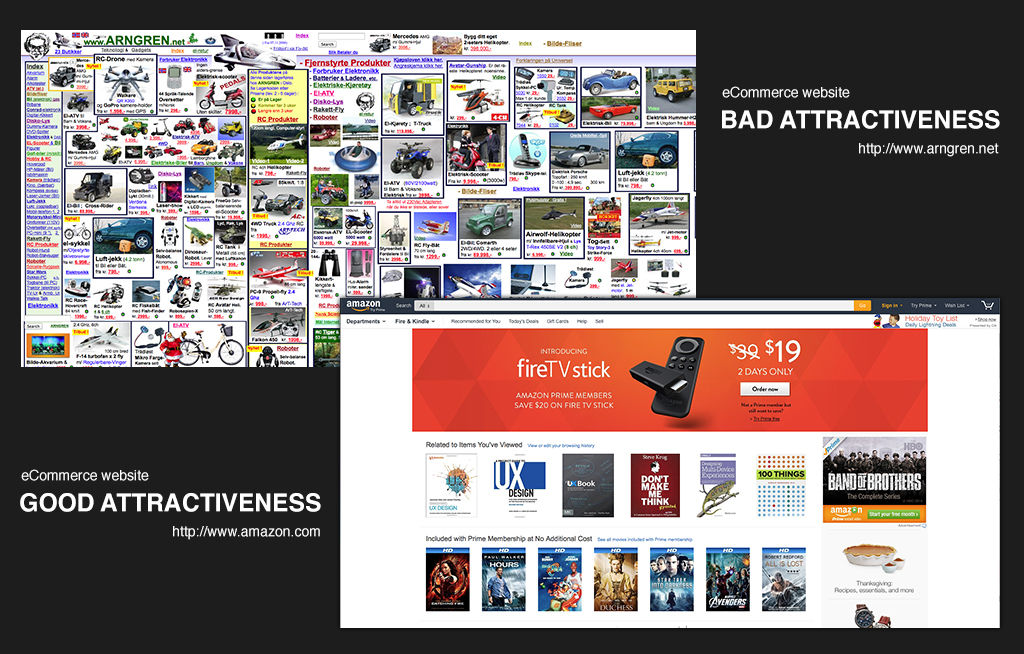
People have always been attracted to dazzler or"attractiveness". We see people who apparel appealingly, and we respond favorably. We see a Ferrari or a Porsche, and our attention is captured by such "headturners". Standards of dazzler exercise differ from culture to culture and person to person. Have you heard the old expression, "in that location's no accounting for taste"? There are, nevertheless, items, people, websites, etc. that the majority of folks detect aesthetically pleasing. Eyes "understand" beauty, no translation required.
For centuries, architecture has harnessed the agreement that beauty matters. Buildings are permanent landmarks, and then it's important to enjoy them. Architects tend to design structures that entreatment to those who live and work in them. Yes, in that location are always exceptions, simply at least the monstrosities will remind us why getting information technology correct is vital!
Attractiveness bias is simply the understanding that we're fatigued to beautiful things. When nosotros encounter a group of people, we tend to see those we detect the most attractive before noticing the rest of the grouping. People with confident smiles and moviestar looks may as well have a spotlight on them. Good wearing apparel make them stand out more than. Speaking of clothes...the same is true when you select jewelry or a garment from a display; the virtually beautiful piece will about "leap out" from the other, less bonny pieces. Yeah, most often it's the most expensive one!
We designers can use this principle of bewitchery bias to help take hold of and hold the attention of users. We can employ it in marketing to drive visits to a website. We tin can also apply information technology to promote one product among many. Apple has done this incredibly successfully, enabling their products to smooth in the consumer listen over many similar products from competitors.
The Brusk-term Effect of Attractiveness
It's important to know that attractiveness bias is a short-lived result. The most beautiful website cannot keep visitors without providing an every bit attractive user experience. Once that "wow factor" has died downwardly, it'southward the utility of a site that holds the attention. Imagine a very good-looking actor turning up for an audience. The casting director will exist impressed; however, our poor actor hasn't mentioned that he's but started interim school. Worse, he'southward not adept at acting and stammers when nervous. Alas, our casting director starts feeling disappointed very quickly.
In essence, while an ugly website may never grab the user'due south attention, a beautiful website without whatever real use volition not hold the user's attention for more than a few seconds. Beauty may be in the heart of the beholder, only the eye gets tired very quickly, almost equally quickly equally it gets turned off by ugliness.
This too explains why an incredibly cute person who lacks intellect or personality may find it very easy to get a first date simply very challenging indeed to get a second.
How Attractiveness Bias can help a website
Bewitchery bias can contribute to the success of a website in a variety of means including:
Increased traffic to the website - An attractive site may draw more users via aesthetic appeal.
Emotional design - As people build an emotional connectedness with attractive people (even those they don't know, such as actors and actresses), then do they class emotional connections with designs that move them or particularly entreatment to them.
Lower bounce rate – Bounciness rate is the time it takes a user to exit a website. An attractive website volition likely hold the attention for longer than an ugly one. However, the primary gene in deciding bounce rate will be the user experience. Pretty pictures tin't hold users for long: get the best of both worlds and heighten your cute design with one that gets users reading and clicking happily.
Increases in fourth dimension on site and folio views - If the website is pleasant-looking and the user feel is positive, information technology's likely that users will spend more time on it.
While attractiveness bias is of import to consider while designing your website, never forget the other one-half of the formula. Meeting the users' needs and desires is in the long term more than important to the success of your design.
Exam your designs to see if they have the desired aesthetic appeal with your audience. A warm, sunny experience may exist very highly-seasoned to the users of a website concerned with children's toys. What most an developed using a horror flick website, though? The graveyard images, blood, gore and haunted nightscapes that they await to detect would scare off toy customers (unless Halloween is coming up and the pictures aren't too shocking!).
Above all, stay mindful of how rapidly the user'southward eye will approximate your design. You lot never get a second chance to brand a starting time impression, and then appeal to your users' senses while you cistron in everything else to proceed them on your folio.
Let'southward at present expect at that "everything else" and how they chronicle back to the look of what we choose to put in our designs. Allow's turn our "money" over and see, shall nosotros?
Form Follows Function
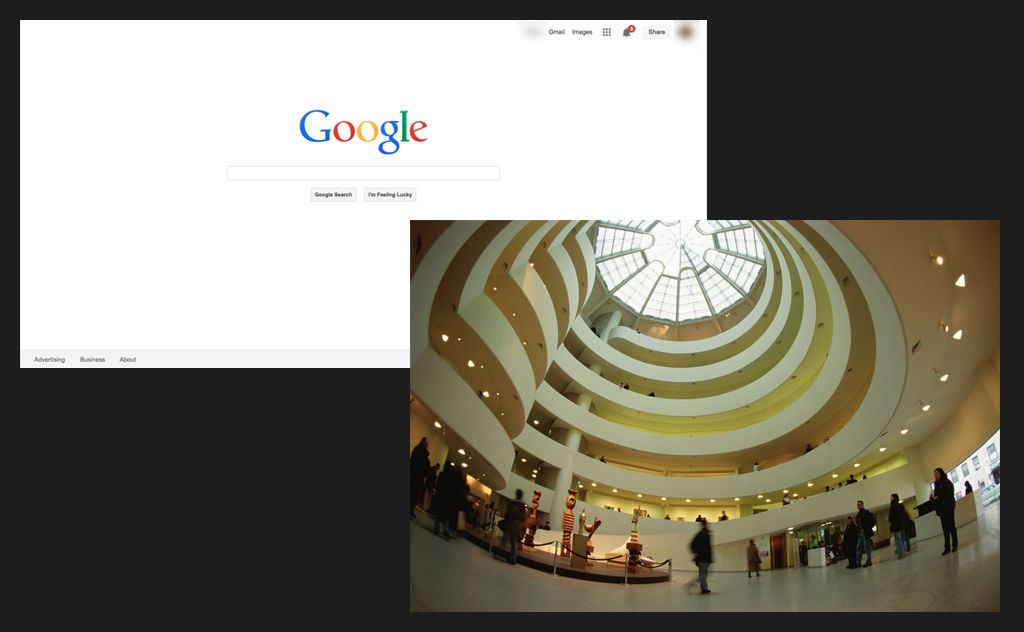
The Guggenheim Museum and Google.com website exemplify how form follows part in blueprint. "Form follows office" is an expression yous'll likely have heard, but what does it really mean? How tin it help us when designing a website?
The phrase "form follows function" indicates that form, or the aesthetic pattern, should be derived from the part that it carries out. In his 1896 commodity, "The Tall Function Building Artistically Considered", American builder Louis Sullivan wrote:
It is the pervading law of all things organic and inorganic, of all things physical and metaphysical, of all things homo and all things superhuman, of all true manifestations of the head, of the eye, of the soul, that the life is recognizable in its expression, that form e'er follows office. This is the law.
Sullivan's assistant, Frank Lloyd Wright, went on to champion this thought ferociously. Ane of his buildings, the Guggenheim Museum, is a good case of form following function, with its spiral shape designed so that visitors can hands view the artwork within the museum.
From the world of blueprint, we accept this quote past Charles Eames that matches the ideas above: "Design is a programme for arranging elements in such a way as best to accomplish a particular purpose."
[Did you miss our "Run across the Eames" article? Cheque information technology out to learn more than about him and his wife Ray and their amazing contribution to design!]
Form Follows Function: Descriptive vs. Prescriptive Interpretation
Writer/Copyright holder: Rose Business organization Technologies. Copyright terms and licence: All rights reserved
Is it true that forms follow function? If that's the case, then there are a couple of means to look at the idea:
The descriptive interpretation – Any beauty in a design must result from the "purity" of the function.
The prescriptive interpretation – Any aesthetic consideration when designing something must e'er take second place to the functional requirements of the design.
The descriptive estimation is piece of cake to dismiss. If we look at nature, mutations in the genome (those which cause evolution) are random. There's no recipe to be followed. A species gets handed a form and and then has to derive its function from that form. (Giraffes might prefer to eat food that grows under the ground, for example, but their long-necked course makes that impossible; thus, their function is to eat leaves from high branches.)
If we were to apply this concept in design, we'd demand to understand that role is more objective than aesthetics (nosotros may both find something usable and useful, but you might consider it ugly, and I might retrieve information technology beautiful, or vice-versa). Remember, there is no bookkeeping for taste.
The prescriptive interpretation also leads to issues. It assumes that functionality is the only imperative for blueprint. Usability, aesthetic entreatment, and simple ergonomics are all secondary to the functionality.
If that were true, then all websites conveying out a similar task should exist identical. After all, if nosotros are to shop online, for example, the process of shopping should be the same each and every time. The functionality is all identical, and the prescriptive interpretation asks the designer to consider, "what should be left out of my design because it fails to serve the function?" There should but be 1 optimal form based on function.
"Grade Follows Office" in Spider web and App Design
If you're going to apply form follows role in your web or app design, you'll have to reach a compromise. Begin past determining what aspects of the pattern (from a functional perspective) are most critical to your design's success. For example, a shop where you cannot place an club or a search engine with no "search box" is going to be somewhat useless!
Once you've decided on your pattern's functionality, you can start to pattern. This doesn't mean eliminating all design elements that distract from the functionality. Recollect, aesthetic appeal matters to users. Still, it can guide united states to using designs that highlight the virtually disquisitional functionality and which, to some extent, disguise less critical functions.
It tin can as well assist, when y'all're time- or resource-poor, to understand where you tin can make trade-offs in the design procedure, both in terms of functionality and aesthetic design. You may make compromises: not to the critical functionality, but to all other functions and to aesthetic appeal. Y'all desire an attractive pattern that draws the user to use it for its chief purpose.
A great example of such compromise is Google.com, which deftly applies the "form follows function" rule. When you access Google's website, all y'all come across is the search field, which is the primary role of the website. Google accept put all other services at the height right-paw corner of the site. Google prioritizes the critical function of search over all other functions.
The Take Away
People are attracted to beauty. Attractiveness bias accounts for this systematic pattern of divergence. Although standards of prettiness differ from culture to culture and according to personal taste, the bulk of folks will enjoy looking at a cute particular, be it a website, a car, or another person. Equally designers, we tin use this bias to our advantage.
Nonetheless, attractiveness bias is a brusk-term effect. The artful appeal of a design volition ebb quickly, fifty-fifty if it has helped to latch with the user, showing in the following:
- Increased traffic to the website
- Emotional pattern
- Lower bounce rate
- Increases in fourth dimension on site and page views
Remembering that we accept a scant amount of fourth dimension in which to hold our user's interest, we must focus on the user experience. This means that we accept to think about who our users are and how we tin show our product, service, or message in the most adapted to their needs and desires.
This is when the idea of Form Follows Function comes into play. If we start with the "function" of the product or service, information technology is more likely that our users volition stay with us subsequently the pretty event wanes. Keep the essential function of your product, service or message firmly in focus, tailoring the aesthetics around it and putting all non-essential aspects on the side, in smaller buttons or bars.
All in all, go along both concepts in heed as you piece of work. Your users don't want a disordered, ugly page. Still, after raising their eyebrows in a moment'due south admiration at the "Mona Lisa" you've shown them, they'll want to navigate quickly to find what they're looking for. Balance is cardinal.
Where To Learn More
- Brandly, South. (2010). Does Course Follow Function? Nifty Magazine. Retrieved from: http://www.smashingmagazine.com/2010/03/23/does-fo... [2014, Sept 1]
- Louis, South. The Tall Office Building Artistically Considered. Triton Higher. Retrieved from: http://academics.triton.edu/faculty/fheitzman/tallofficebuilding.html. [2014, Sept 1]
- Encounter the Eames: Function is the central to pattern. https://www.interaction-design.org/literature/arti...
Resource
Hero Image: Author/Copyright holder: Unknown. Copyright terms and licence: Unknown.
Source: https://www.interaction-design.org/literature/topics/aesthetics
0 Response to "Must Art Be Pleasing in Order to Be Good"
Post a Comment