Mtg Card Discarded in Clean Up Again and Again
The Rules of Magic: The Gathering are the rules governing the play of the bill of fare game Magic: The Gathering. The original rules were developed by the game's creator, Richard Garfield, and accompanied the first version of the game in 1993. The rules of Magic have been changed frequently over the years by the manufacturer, Wizards of the Coast, mostly in minor means. However, major rules overhauls have also been done a few times. Furthermore with the introduction of new cards and mechanics the rules governing these are constantly added to the rulebook.
While the core rules of Magic, that a beginner needs to learn in order to start playing, are rather like shooting fish in a barrel to learn, the complete rule set fills an e'er-growing rulebook of over 200 pages, named Magic: The Gathering Comprehensive Rules.
In its most-played form, Magic is a game where two players bring their own set of cards, chosen a deck, and play each other. Players showtime by drawing a manus of seven cards and so accept turns. In a turn a histrion can play one mana-producing Land, play various types of spells which require varying amounts and colors of mana, and attack their opponent to endeavor and reduce their life full from the starting 20 to nix, thus winning the game.
Overview [edit]

A game of Magic in progress
A standard game of Magic involves two or more players who are engaged in a boxing acting as powerful wizards, known as Planeswalkers. Each actor has their own deck of cards, either one previously constructed or made from a express pool of cards for the event.[ane] A thespian typically starts the game with a "life total" of 20 and loses the game when their life total is reduced to zero.[2] [3] A actor tin can besides lose if they must depict from an empty deck. Some cards specify other ways to win or lose the game.[two] Additionally, the "Gilt Rule of Magic" states that "whenever a card's text directly contradicts the rules, the menu takes precedence".[2] CNET highlighted that the game has many variants; also, "Magic tends to embrace all that house ruling, making information technology official when it catches on. Commander started as a fan-created format, after all".[4]
Formats [edit]
There are various formats in which the Magic can be played. Each format provides boosted rules for deck construction and gameplay, with many confining the puddle of permitted cards to those released in a specified grouping of Magic bill of fare sets. Formats are divided into two main categories by the Wizards Play Network: Tournament and Coincidental.[5] The term "sanctioned" refers to formats that the Wizards Play Network allows to be run at official events.[vi] Officially sanctioned events can too add additional rules such every bit disallowing proxy cards.[7]
A number of other formats have been designed by Wizards of the Coast or by players themselves for custom gameplay or reduced investment cost; these are known as casual formats.[eight] Some casual formats utilize rules or sets of cards that differ from those used in sanctioned tournament play. One of the virtually popular formats of Magic is the Commander format which is technically a coincidental sanctioned format.[9] [ten] [11]
Formats can further be divided past if they are Synthetic and Limited formats.[12] [4] Constructed formats require decks to be made prior to participation, with players allowed to use any tournament-legal cards they possess. Sanctioned Synthetic formats include Standard, Modern, Legacy, and Vintage.[12] Limited formats, in contrast, utilize a restricted and unknown pool of cards, usually formed by opening Magic products. Limited competition require players to select cards and build decks on the wing inside the tournament itself. The primary two sanctioned Limited formats are Sealed Deck and Booster Draft.[12] [13]
Deck structure [edit]
Deck edifice requires strategy equally players must choose among thousands of cards which they want to play. This requires players to evaluate the power of their cards, besides every bit the possible synergies between them, and their possible interactions with the cards they expect to play against (this "metagame" can vary in different locations or fourth dimension periods).[14] [xv] The choice of cards is commonly narrowed by the role player deciding which colors they desire to include in the deck.[sixteen] [15] Role of the Magic production line has been starter decks which are aimed to provide novice players with ideas for deck edifice.[17] Players expand their card library for deck building through booster packs, which have a random distribution of cards from a specific Magic ready and defined by rarity. These rarities are known as Common, Uncommon, Rare, and Mythic, with generally more powerful cards having higher rarities.
Initial setup [edit]
Beginning and ending the game [edit]
Each role player uses their own deck to play the game. In about formats, a deck must have a minimum of 60 cards;[xviii] [3] there is no maximum deck size, but a player must be able to shuffle their deck without assistance.[19] Some formats accept exceptions or boosted limitations to the above rules.[three] In tournaments, players may be allowed the use of a sideboard containing up to 15 cards. Sideboard cards can be swapped for cards in the main deck in between games against the same opponent.
At the start of a game, each thespian shuffles their deck. Players then decide who will start, using any mutually agreeable method. Each player and so draws seven cards from their deck, otherwise known every bit a library, in order to form their starting hand.[20] [three] The players may cull to mulligan if they don't like their starting mitt.[21] [3]
A actor wins the game by eliminating all opponents. Players typically begin the game with xx life and lose when any of the following conditions are met:
- That player has 0 or negative life
- That actor is required to depict a card but has no cards left in their library
- That player has 10 or more poison counters (although cards that use poison are not printed frequently)
- That actor has taken at least 21 combat damage from a "commander" (in commander formats)
- That player concedes
- Specific cards may also dictate (or foreclose) other ways of winning or losing the game
London Mulligan [edit]
The London Mulligan rule was implemented for all competitive Magic formats in 2019. In turn order, each thespian may determine to mulligan; that role player shuffles their hand and library together and draws a new mitt of seven cards. A role player can do this equally many times every bit they wish. They then put a card on the bottom of their library for each time they took a mulligan.[21] [22] [23]
Zones [edit]

Magic: The Gathering zones.
At whatever given time, every bill of fare is located in i of the following "zones":
- Library: The portion of the player's deck that is kept confront down and is ordinarily in random order (shuffled).[24] When drawing a card, it is always the elevation card of the library.
- Hand: A player'southward hidden manus of cards that can be played. If a player has more than seven cards in hand at the end of their turn, whatsoever extras must exist discarded.[25]
- Battlefield: The zone where cards of the permanent type are placed and stay until otherwise removed. Dissimilar other zones, the battlefield is shared by all players.[25]
- Graveyard: A player's discard pile.[24] [26] Typically, "creatures, enchantments, and artifacts stay on the playing field whereas sorceries and instants are placed in your discard pile [...] after casting their one-fourth dimension effect".[26]
- The stack: This is the place for spells and abilities that have been cast or played, simply take not yet resolved. This zone is also shared past all players.[25] [27]
- Exile: Cards that have been exiled past specific furnishings are put here. Dissimilar the graveyard, exile is "the identify where cards go when they're really expressionless and can't be replayed back into the game".[24]
- Command: Used mainly in some variant formats of play, cards that have a special status or abilities within the game are kept here. Cards in the Command Zone can exist afflicted by nearly nothing that affects cards in the other zones.
Terminology [edit]
Abilities [edit]
There are 4 full general categories of abilities:
- Spell abilities: abilities that are followed as instructions while an instant or sorcery spell is resolving. Any text on an instant or sorcery spell is a spell ability unless it's an activated power, a triggered power, or a static ability.[28]
- Activated abilities: abilities that have a cost and an effect. They are written as "[Cost]: [Effect.] [Activation instructions (if whatsoever).]" A player may activate such an ability whenever they have priority. Doing and then puts it on the stack, where it remains until it's countered, it resolves, or it otherwise leaves the stack.[29] [28]
- Triggered abilities: abilities that have a trigger status and an effect. They are written every bit "[Trigger condition], [consequence]", and begin with the word "when", "whenever", or "at". Whenever the trigger event occurs, the power is put on the stack the next time a player would receive priority and stays there until it's countered, it resolves, or it otherwise leaves the stack.[30] [28]
- Static abilities: abilities written as statements. They're but true, and practice not utilize the stack. Static abilities create continuous furnishings which are active while the permanent with the power is on the battlefield and has the ability, or while the object with the ability is in the appropriate zone.[31] [28]
Keyword abilities [edit]
Some cards have abilities that are non fully explained on the menu. These are known as "keyword" abilities, and consist of a word or phrase whose meaning is defined by the rules. Keyword abilities are commonly given reminder text in the set in which they are introduced. There are over forty such abilities. In near cases, multiple instances of the aforementioned keyword on an object accept no additional effect. Keywords can be classified into two different types: Evergreen or Mechanics.[32] [33] Evergreen keywords "can appear in absolutely any prepare, since its gameplay effects and season are flexible and generic plenty to fit anywhere. Effects like bruise, flying, deathtouch, first strike and haste are examples of this".[34] Abilities classified as Mechanics are rotated in and out of the game as various expansions are released.[35] [36] [37] Game Rant highlighted that "almost planes take some unique rules that are only relevant on cards from specific sets" and that "new mechanics are constantly added to shake things upwards and give the players new tools to work with".[36]
Mana [edit]
When a role player uses an power that produces mana, that mana is put in their "mana pool". In that location are five colors of mana: white, blue, black, red and green. Mana tin can also be colorless. Mana in the mana pool tin can be used to pay costs.[26] [38] [39]
Types of cards [edit]
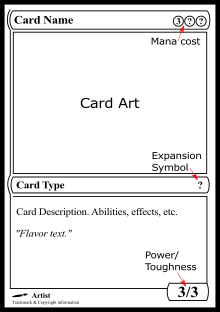
Dissection of a Magic: The Gathering card.
All objects that remain on the battleground are called permanents. Types of permanents include lands, creatures, enchantments, artifacts, and planeswalkers. In dissimilarity, sorceries and instants go to the graveyard immediately later on they are used.[xl] [41]
Lands [edit]
State cards tap to produce mana that is used to bandage spells and actuate abilities. They cost no mana to play; withal, a histrion may play no more than one land per turn, and just during the main phases of their ain plow.[40] [24] There are vi types of bones lands (Plains, Island, Swamp, Mount, Wood, and Wastes), one for each color (plus Wastes for colorless). These lands can each exist tapped to produce one mana of the appropriate color. Other lands are non-basic and may produce other combinations or amounts of mana, or may have other abilities.[24] [26] [41] Playing a land does non utilise the stack and therefore occurs immediately, with no way for any player to stop it. Players are allowed to have whatever number of basic lands in a deck, just nonbasic lands follow the usual brake of four copies of whatsoever 1 card per deck.
Creatures [edit]
Creatures represent people or beasts that are summoned to the battlefield to assault opposing creatures or players and defend their controller from the attacks of enemy creatures.[26] [24] Creatures take two values that correspond their strength in combat, printed on the lower right-hand corner of the carte du jour. The outset number is the beast's power, the amount of damage it deals in gainsay. The second number is its toughness; if it receives that much damage in a single turn, the creature is destroyed and placed in the graveyard.
Creatures usually have at least one creature type, located after the word "animate being" in the type line. Animate being types are simply markers and have no inherent abilities; for instance, having the Bird blazon does non automatically give a beast the "flying" ability. Some non-creature cards take the "Tribal" type, which allows them to have creature types without existence creatures themselves.
Enchantments [edit]
Enchantments represent persistent magical effects; they are spells that remain on the battlefield and alter some aspect of the game.[26]
Some enchantments are attached to other cards on the battlefield (often creatures); these are known equally Auras. They describe what they tin be fastened to in their "Enchant <something>" ability. For case, an Aura with "Enchant light-green creature" tin but exist attached to a dark-green creature. If the card an Aureola is attached to leaves the battleground, or stops matching the Enchant ability, the Aura goes to the graveyard.
Early on in Magic, there was a subset of enchantments known equally "Globe Enchantments" that affected all players equally (for example, forcing them to play with their top card of their library revealed). In addition, only one Globe Enchantment could exist in play at a time. Such enchantments no longer need to comport the "World" designations. Later, Tribal Enchantments (Enchantments with creature types) were introduced, every bit were Curses, enchantments that targeted 1 player specifically.
Artifacts [edit]
Artifacts represent magical items, animated constructs, pieces of equipment, or other objects and devices. Similar enchantments, artifacts remain on the battlefield until something removes them.[26] Many artifacts are also creatures; artifact creatures may attack and block as other creatures, and are affected by things that affect creatures.
Some artifacts are Equipment.[26] Equipment cards enter the battleground just like any other artifact, but may be fastened to creatures using their Equip power. This ability may just be used at the same time a player would be able to play a sorcery (i.e. simply during the main phases of the player who controls it). The player who controls the Equipment pays the Equip price and attaches it to a creature they also control, unattaching it from any beast it was already attached to. In this way, the Equipment may be "unequipped" from a creature by paying the Equip toll and moving information technology to another creature. However, it may not be "unequipped" by choosing no creature; if for whatsoever reason the Equip ability cannot move the Equipment, it remains attached to its current creature. Similar Auras, if control of the equipped animate being changes, control of the Equipment does not change, nor is it unequipped. Dissimilar Auras, if an equipped animate being is destroyed or otherwise leaves the battlefield, the Equipment stays on the battlefield unattached to anything; its controller tin still attach it to a dissimilar fauna by activating the Equip ability again. A player can only equip equipment to creatures controlled by that thespian.
Sorceries and instants [edit]
Sorceries and instants both represent 1-shot or short-term magical spells. They never enter the battlefield. Instead, they take effect and then are immediately put into their owner's graveyard.[26]
Sorceries and instants differ only in when they can exist cast. Sorceries may only exist cast during the player'due south ain chief phases,[26] and just when the stack is empty. Instants, on the other paw, tin can exist bandage at whatsoever fourth dimension, including during other players' turns and while another spell or ability is waiting to resolve.[26]
In sets released prior to 1999, a third type of one-shot spell bill of fare existed called Interrupts. Interrupts functioned similar to instants but altered how the stack was resolved. Interrupts received an errata which stated that, from that betoken frontwards, interrupts were treated exactly the same as instants.[42]
Planeswalkers [edit]
Planeswalkers are extremely powerful spellcasters that tin be chosen upon for aid.[3] According to Magic lore, the player is a "planeswalker", a wizard of boggling power who tin travel ("walk") between different realms or universes ("planes"); equally such, planeswalker cards are meant to correspond scaled-down versions of other players, with their decks represented by the bill of fare's abilities, and originally were designed to move through a roster of effects without role player control, as though they had a listen of their own.[43] Each planeswalker has a planeswalker type, which is a truncated version of their name. Only 1 version of a planeswalker bill of fare may be on the battlefield at once. If ii or more copies of the same planeswalker bill of fare are on the battlefield, their owner chooses i and the other is put into the owner'south graveyards, though the rule was changed in Magic 2022 allowing 2 or more planeswalkers with the same type to be on the battlefield if non controlled by the same role player. Starting with Ixalan, all planeswalkers past, nowadays, and future gained the supertype legendary and became subject to the "legend rule". Thus, if a player controls more than than one legendary planeswalker with the same name, that player chooses 1 and puts the other into their possessor's graveyard.[44]
Planeswalkers' abilities are based on their loyalty, which is tracked with counters. The number printed in the lower right corner indicates how many loyalty counters the planeswalker enters the battlefield with. Planeswalkers' loyalty abilities each have a positive or negative loyalty cost; this is how many counters must be added (if positive) or removed (if negative) to activate that power. Abilities with negative loyalty costs may only exist activated if there are plenty loyalty counters to remove. Regardless of the loyalty costs, a single planeswalker may only use i loyalty ability once per plow, and only on its controller's turn during their primary phases.[45]
Note that planeswalkers are neither creatures nor players, so well-nigh spells and abilities cannot target them directly. If a player attacks an opponent who controls a planeswalker, the player may declare any or all of the attacking creatures to be attacking the planeswalker instead. Those creatures may be blocked commonly, just if non blocked deal damage to the planeswalker instead of the player. Whenever damage is dealt to a planeswalker, that many loyalty counters are removed from it. A planeswalker with no loyalty counters, either through use of its abilities or through damage, is put into the player'southward graveyard.
Gameplay [edit]
Phases [edit]
Magic officially labels its gameplay phases "equally Brainstorm, Main Phase, Combat, Second Main Phase, and Terminate".[26]
Begin [edit]
The beginning stage is composed of 3 parts:[46]
- Untap step: A player untaps all cards they control.[47] [48]
- Upkeep step: Then, any abilities that trigger on the "upkeep step" happen, starting with the histrion of the current plow. These oft include cards that require mana payments every turn.[47] [48]
- Describe step: A player then draws a carte.[47] [48] In two-player games, the player who takes the starting time turn does not draw a card for that turn.
No actor receives priority during the untap step, meaning that no cards or abilities can be played at that time. During the upkeep and describe steps, however, players tin can cast instants and activate abilities as normal.[47] [48]
Main [edit]
The main phase occurs immediately after the draw stride; in this phase, the player has option to put cards onto the field. They may play whatsoever menu from their hand unless that card specifies otherwise, and as long equally they accept the mana to pay its casting toll. This includes creature, planeswalker, sorcery, instant, land, enchantment, and artifact cards.[47] [48] In contrast, "opponents can only play instants or abilities at this time (non creatures, sorceries, etc). Main phases are also the just time that you can play lands".[48]
Combat [edit]
The gainsay phase is split into five steps. Aside from instants, activated abilities, and spells that are specifically noted equally being able to exist played at whatever time (eastward.g., creatures with flash), players may not cast spells during combat. Multiple creatures may attack at the same time, simply the plow role player may only declare their list of attackers once.[47] [48]
- Kickoff of combat: no specific actions have place at the beginning of combat step. This stride mainly exists to permit players to cast spells and activate abilities that may modify how combat progresses. As the most mutual example, but untapped creatures may attack, so the defending role player may bandage instants or activate abilities that volition tap a creature, preventing it from attacking.[47] [48]
- Declare attackers: the player whose turn it is declares which creatures they control will set on. Both players are given a risk to cast instants and activate abilities after attackers take been declared.[47] [48]
- Declare blockers: subsequently the attacking actor declares attackers, the defending player chooses which creatures they volition block with. A fauna must be untapped in social club for information technology to block. Each creature can just cake a single attacker, simply the defending player may cull to cake an attacking creature with more than than ane creature. Both players are given a take a chance to bandage instants and activate abilities after blockers have been declared.[47] [48]
- Combat harm: attacking and blocking creatures deal damage; the stack is used to make up one's mind the social club this occurs.[47] [48]
- End of gainsay: Like the offset of gainsay, nothing normally happens during this phase. When the terminate of combat step finishes, all cards are no longer in combat.[47] [48]
Second main phase [edit]
The second main phase is identical to the starting time; players may bandage spells and play lands. Any unspent mana is discarded.[46] [47]
Cease [edit]
The catastrophe phase has ii steps:
- End stride: abilities that trigger "at the beginning of the end pace" go along the stack. This is the last run a risk players accept to cast instants or activate abilities this turn.[47] [48]
- Cleanup: the active player discards downwardly to their maximum hand size, then simultaneously, all damage marked on permanents is removed and all "until finish of plough" and "this turn" effects end.[47] [48] "Additionally, no one tin can play spells or abilities during this step unless an power specifically triggers to allow that to happen".[48]
Later this stage is completed, the next active actor starts their turn at the beginning stage.[47]
Paying costs [edit]
Tapping and untapping [edit]

The tap symbol, which appears on cards to bespeak that a certain skill requires the bill of fare'south tap to be used. This is the first version of the symbol, printed on cards from the Revised Edition to Fallen Empires.
Some spells or abilities crave the player to tap a permanent as part of their cost. To indicate that a card in play has been tapped, information technology is turned sideways. An ability or spell that requires borer cannot be used if the permanent is already tapped. Furthermore, a tapped creature cannot be declared every bit an assaulter or blocker.
Instead of a cost, tapping tin also be the consequence of a spell or ability. In such a instance, it makes no difference if that permanent was already tapped. A beast that attacks besides gets tapped, unless it has vigilance, but a defending creature does not. Unless stated otherwise, tapping does not stop continuous abilities (e.grand. enchantments or equipments) or triggered abilities from taking effect, nor does it disallow the use of abilities that do non require tapping.
At the beginning of each thespian'south turn, that actor untaps all cards they command (unless otherwise stated by a carte'southward effect) and tin exist tapped once again equally normal.
Mana costs and colors [edit]
Most cards other than lands have a mana cost. This is the corporeality of mana that must be spent to cast that card as a spell. Each mana symbol in the top correct corner of the carte du jour represents i mana of that color that must exist paid. A number in a gray circle side by side to the mana symbols represents how much additional generic mana must exist paid; this boosted mana can be of whatever colour or colorless. Some cards may require their owner to pay mana of ii or more colors. These cards are multicolored. Some multicolored cards as well use hybrid mana, which can be paid with one of two unlike colors. If a player has leftover mana, called "floating", it can be used any time during the remainder of the phase. Any floating mana left over when a actor gain to the next stage is depleted. Additionally, some cards accept Phyrexian mana in their costs. Phyrexian mana can be paid with either one mana of that color or with 2 life.
Screen Rant commented that "One of the more important aspects of amalgam a deck is the mana ratio. This ratio determines how many basic land cards players will demand in their deck in gild to 'cast' spell cards for combat and defence when playing a game. Too much mana can lead to players becoming 'mana swamped' or pulling out by and large basic mana cards and not enough spell cards to set on. The reverse can likewise happen where players become 'mana starved' and have too little mana to play their spell cards. [...] In that location are a number of ways the calculate or judge this more specifically, but a quick rule of thumb is that basic mana should make up approximately one-tertiary of their Magic: The Gathering deck, or twenty to 24 cards in a 60-carte du jour deck".[49]
Timing [edit]
The near versatile aspect of Magic is that after well-nigh spells and abilities are bandage or activated, merely before they really take effect ("resolve"), all players become a chance to "respond" to them. This means they can cast a unlike spell or actuate another ability that will resolve first, often either invalidating or reinforcing the consequence of the first spell. The mechanism that accomplishes this is chosen "the stack". It is where spells and abilities become to wait for any responses that may go played.
Spells that are permanents that stop upwards on the battlefield; sorcery spells; and abilities that say "activate this ability only any time you could cast a sorcery" cannot be cast or activated equally responses. They can only be bandage or activated when the stack is empty, just on the plow of whoever casts or activates them, and only in a main phase. In dissimilarity, activated abilities, instant spells, and spells that have the power flash can be played on anybody's plow and in most steps of the game, get on the stack "on acme of" anything that is already at that place, and will resolve first. Many players refer to this difference as "speed", just that is a misleading term, because neither is "faster" than the other; the just departure is when they can be played.
Playing lands, almost abilities that produce mana, and certain other special deportment do not apply the stack; they bypass the rules below and have effect immediately.
The stack [edit]
When a player casts a spell or activates an power, information technology does not immediately accept result. Instead, it is placed on the stack. That player then receives priority once more, which gives him or her a chance to respond to it with spells or abilities. Each new spell or power is put on top of the stack in plough, with the newest on summit and the oldest at the lesser. A player with priority can add together as many spells or abilities to the stack as they can pay for, but is not required to; if a player declines to respond to the latest spell or ability, they "passes priority" to the side by side thespian in turn social club.
When all players have passed priority in succession, the peak-nearly spell or ability on the stack resolves. If it was a sorcery, instant, or ability, the role player carries out the instructions; if information technology would create a permanent, it enters the battlefield. Every fourth dimension a spell or ability finishes resolving, players (starting with the histrion whose plough it is) can in one case over again add more to the stack; if they don't, the new peak-nigh spell or ability will resolve.
When the stack is empty, the player whose turn information technology is gets priority first. If all players laissez passer priority while the stack is empty, the game proceeds to the next stride or phase of the turn.
Countering [edit]
Sure spells (and abilities) allow a player to counter other spells (or abilities). These spells must be cast while the spells they volition bear upon are still on the stack. If a spell is countered, information technology is moved from the stack to its possessor's graveyard when counterspell resolves. It does not resolve, and has no effect unless the card states otherwise. If the spell would create a permanent, information technology never enters the battleground. Some spells state that they cannot be countered.
History [edit]
Magic's Comprehensive Rules[50] [51] aim to "stabilize the rules" with errata and outline "special-case rulings".[52] In Apr 1994, Wizards of the Coast made "the first endeavor to formalize and simplify Magic rules" with the Revised Edition carte du jour set.[52] This codification of rules streamlined many cards, introduced or clarified many terms, removed "the need for multiple artifact types" and "introduced the tap symbol".[52] The most of import modify was that it introduced the system of timing that is in similar form all the same used in the game today: LIFO ("final in, first out"). This timing "system brought an stop to simultaneous spell resolution and the arguments it created."[52] Spells were now announced in 'batches'. However, over the next twelvemonth it became articulate that the game needed a more detailed rulebook. This led to the development of the Comprehensive Rules which were introduced in mid-1995 with the 4th Edition card set.
The Comprehensive Rules were again overhauled for the 1997 Fifth Edition card set up.[52] The "Fifth Edition rules were an attempt to formalize the whole game rules into a complete system for the first time. Instead of case by case rulings, menu interactions should follow logically from the comprehensive rules. "Fifth Edition rules changed interrupts to work remarkably like instants, simplified the assail, and introduced several 'new' concepts that had never had formal names (including phase costs and triggered abilities)."[52] Fifth Edition also introduced on-menu reminder text to keywords with the goal of helping beginners to larn the various keywords of the game more easily. The rules were reworked more drastically for the Archetype Sixth Edition core set in 1999. Instead of spells resolving every bit complete batches players could now interact on the "stack" at any point, interrupts were removed from the game, combat damage used the stack, and the rules deactivating tapped artifacts and preventing tapped blockers from dealing damage were removed.
The side by side major rules update was a decade later with the Magic 2010 core set.[53] Several rule changes were fabricated with the goal of making the game terminology more flavorful such equally renaming the "in play-zone" to "battlefield". The main change was that gainsay stopped using the stack, a change that was considered by many veterans of the game to reduce the strategic depth of combat situations although it was mostly accustomed that in many cases the difference would not bear upon the combat state of affairs.[54]
Banned and restricted cards [edit]
Individual cards may be listed as "restricted", where just one copy can exist included in a deck, or simply "banned", at the WPN's discretion.[five] These limitations are commonly for balance of power reasons, just have been occasionally made considering of gameplay mechanics.[55] [56] [57] For instance, with the emptying of the "play for ante" mechanic in all formal formats,[58] all such cards with this feature are banned.[55] During the COVID-19 pandemic which drew more players to the online Magic games and generated volumes of data of popular deck constructions, Wizards was able to track pop combinations more quickly than in a purely newspaper game, and in mid-2020, banned additional cards that in specific combinations could depict out games far longer than desired.[59]
Older cards take also been banned from all formal play by Wizards due to inappropriate racial or cultural depictions in their text or illustrations in the wake of the George Floyd protests, and their images have been blocked or removed from online Magic databases.[60] [61] This included a bill of fare chosen "Invoke Prejudice", which was displayed on the official bill of fare index site Gatherer "at a spider web URL ending in '1488', numbers that are synonymous with white supremacy."[61]
References [edit]
- ^ "Magic for the Masses: So You lot Want to Play Magic: The Gathering?". Paste. 2015-02-27. Retrieved 2021-10-16 .
- ^ a b c "Magic: The Gathering Comprehensive Rules" (PDF). The DCI. September 24, 2021. pp. 6–10. Retrieved October 17, 2021.
- ^ a b c d eastward f "How to play Magic: The Gathering: A beginner's guide". Dicebreaker. 2019-11-21. Retrieved 2021-10-16 .
- ^ a b Lancaster, Luke (January 26, 2017). "'Mix and match' makes many kinds of Magic: The Gathering". CNET . Retrieved 2021-10-17 .
- ^ a b "Magic: the Gathering® Tournament Rules Effective July 23, 2021" (PDF). Wizards Play Network. July 23, 2021. Retrieved September 15, 2021.
- ^ "All Formats". Wizards of the Declension. Retrieved 17 October 2016.
- ^ "WotC Clarifies Proxy Position on 'Magic'". icv2.com . Retrieved 2021-09-15 .
- ^ "Casual Formats". Wizards of the Declension. Archived from the original on October sixteen, 2008. Retrieved nine November 2011.
- ^ Hall, Charlie (2020-05-28). "Commander: The definitive history of Magic'south virtually pop format". Polygon . Retrieved 2021-09-xiv .
- ^ Johnson, Xavier (2021-07-30). "Deckbuilding thrives in Magic: The Gathering'south casual format Commander". Dot Esports . Retrieved 2021-09-14 .
- ^ "Magic: The Gathering'due south virtually popular formats explained". Dicebreaker. 2020-01-14. Retrieved 2021-09-14 .
- ^ a b c "Sanctioned Formats". Wizards of the Declension. Retrieved 17 October 2016.
- ^ "Magic for the Masses: Drafting for Dummies". Paste. 2015-04-28. Retrieved 2021-ten-sixteen .
- ^ "A Beginners Guide to Magic the Gathering". Kim E Lumbard. 2003. Archived from the original on Nov six, 2015. Retrieved July 24, 2009.
- ^ a b "Magic for the Masses: Standard Deck Construction on a Budget". Paste. 2015-03-23. Retrieved 2021-ten-16 .
- ^ "Magic The Gathering Tips". oshkoshmagic. Archived from the original on October half dozen, 2013. Retrieved July 25, 2013.
- ^ Carrillo, Jaime (June 13, 2019). "Magic: The Gathering: A definitive guide to MtG for beginners". The Daily Dot . Retrieved Feb 29, 2020.
- ^ "Standard". Magic: The Gathering.
- ^ "Modern Format". Magic: The Gathering.
- ^ "Share the Spark". Magic: The Gathering.
- ^ a b "Magic: The Gathering - When & Why to Mulligan Your Hand". CBR. 2020-07-x. Retrieved 2021-10-16 .
- ^ "Magic: The Gathering is Getting a New Mulligan Dominion". ScreenRant. 2019-06-03. Retrieved 2021-x-xvi .
- ^ Forster, Danny (2019-06-03). "Magic: The Gathering will implement London Mulligan dominion across all formats". Dot Esports . Retrieved 2021-10-16 .
- ^ a b c d e f "How to play Magic the Gathering Loonshit: getting started in MTG". PCGamesN. October 1, 2021. Retrieved 2021-10-16 .
- ^ a b c "How to Play". Magic: The Gathering . Retrieved 2021-10-16 .
- ^ a b c d e f g h i j k l Orf, Darren (2020-08-11). "So You Desire to Play 'Magic: The Gathering'". Popular Mechanics . Retrieved 2021-x-sixteen .
- ^ "How to Play 'Magic: The Gathering': The Stack". GeekMom. 2021-02-nineteen. Retrieved 2021-10-16 .
- ^ a b c d "Magic: The Gathering Basic Rulebook" (PDF). Wizards of the Coast . Retrieved October xvi, 2021.
- ^ "CR 602. Activating Activated Abilities". Rules Resources.
- ^ "603. Handling Triggered Abilities". magiccards.info.
- ^ "CR 604. Handling Static Abilities". Rules Resources.
- ^ "Elevation 10 Evergreen Keywords by Abe Sargent". GatheringMagic.com . Retrieved 2018-05-09 .
- ^ "Magic the Gathering: Arena keyword abilities explained". PCGamesN. February 3, 2021. Retrieved 2021-10-16 .
- ^ "How Scrying Became Magic: The Gathering's Newest Evergreen Keyword". CBR. 2021-05-07. Retrieved 2021-10-17 .
- ^ "The 5 Mechanics You Need to Know to Play 'Magic the Gathering: Kaldheim'". GeekMom. 2021-01-28. Retrieved 2021-10-16 .
- ^ a b "Magic: The Gathering Strixhaven Mechanics Explained". Game Rant. 2021-03-29. Retrieved 2021-10-16 .
- ^ Goldberg, J. R. (March 30, 2017). "Magic: The Gathering's Caput Designer Has A Damn Difficult Chore". Kotaku . Retrieved 2021-10-17 .
- ^ Gutierrez, Carlos (Nov 12, 2014). "Take Command of Your Mana]". CoolStuffInc . Retrieved 2021-ten-17 .
- ^ Howard, Jeff (2014). Game Magic: A Designer'southward Guide to Magic Systems in Theory and Practice. Boca Raton, FL: CRC Press, Taylor and Francis. pp. 105–110. ISBN978-1-4665-6787-0. OCLC 878262785.
- ^ a b Mitchell, Ferguson (2019-07-15). "MTG nuts: Introduction to Magic: The Gathering". Dot Esports . Retrieved 2021-x-16 .
- ^ a b "Magic: The Gathering 101 – Deck Building Fundamentals". Nerdist. 2018-05-30. Retrieved 2021-ten-16 .
- ^ "Magic: The Gathering - Classic Edition Alphabetic character". www.wizards.com. January 15, 1999. Archived from the original on December 15, 2018.
- ^ Rosewater (2009-10-02). "Planeswalk on the Wild Side, part 1".
- ^ Matt Tabak. (August 28th, 2017) "Ixalan Mechanics"
- ^ "Magic: The Gathering Planeswalker Rules". 2008-03-26.
- ^ a b "Magic: The Gathering Arena - the beginner'due south guide". PC Invasion. 2019-11-xiii. Retrieved 2021-10-17 .
- ^ a b c d east f g h i j grand 50 m n o "Magic The Gathering Turns Explained: Stage Guide". TheGamer. 2021-09-24. Retrieved 2021-10-17 .
- ^ a b c d e f g h i j k l one thousand n o Knutson, Ted (November iv, 2006). "The Dynamics of a Plow". Magic: The Gathering . Retrieved 2021-10-17 .
- ^ "How To Build A Magic: The Gathering Standard Format sixty-Card Deck". ScreenRant. 2021-10-eleven. Retrieved 2021-10-16 .
- ^ "Rules". Magic: The Gathering . Retrieved 2021-x-17 .
- ^ Nelson, Joshua (2019-09-27). ""Magic: The Gathering" Comprehensive & "Oracle" Rules Changes". Bleeding Cool News And Rumors . Retrieved 2021-x-17 .
- ^ a b c d e f Gray, Dan (June one, 2009). "Simple Rules are the Holy Grail of Magic". Magic: The Gathering . Retrieved 2021-10-17 .
- ^ "Magic 2010 Rules Changes". Magic: The Gathering. June 10, 2009. Retrieved 2021-10-17 .
- ^ Henke, Tobias (June xix, 2009). "Berechtigte Zweifel" (in High german). planetmtg.de. Retrieved October 18, 2021.
- ^ a b "Magic: The Gathering - Early on, the Game Was Just Plain WEIRD". CBR. 2020-12-05. Retrieved 2021-ten-17 .
- ^ "Magic: The Gathering - Making Sense of the Fable Rule". CBR. 2020-12-12. Retrieved 2021-x-17 .
- ^ LaPille, Tom (July 26, 2009). "Crafting a Vintage". Wizards of the Coast. Retrieved July 24, 2009.
- ^ "Magic: The Gathering'due south Worst Mechanic Was Banned to Avoid Gambling Accusations". CBR. 2021-12-xix. Retrieved 2021-12-xx .
- ^ Gault, Matthew (Baronial v, 2020). "COVID-19 Is Making 'Magic: The Gathering' Change the Game". Vice . Retrieved August five, 2020.
- ^ Parrish, Ash (June 10, 2020). "Wizards of the Coast Bans 7 Racist Magic: The Gathering Cards". Kotaku . Retrieved 2020-06-eleven .
- ^ a b Hall, Charlie (2020-06-10). "Racist Magic: The Gathering cards banned, removed from database past publisher". Polygon . Retrieved 2020-06-11 .
Farther reading [edit]
- Wylie, Tom (Fall 1994). "Murk dwellers: The Magic rules you've never heard of". The Duelist. No. 3. Wizards of the Coast. p. 14-15.
- Wylie, Tom. "Murk dwellers". The Duelist. No. iv. Wizards of the Coast. p. 20-22.
External links [edit]
- Magic: The Gathering Comprehensive Rules
Source: https://en.wikipedia.org/wiki/Magic:_The_Gathering_rules
0 Response to "Mtg Card Discarded in Clean Up Again and Again"
Post a Comment